8.08.2012

Olympic Men's Boxing


From the Examiner "The five best prizefighters to win Olympic gold since 1984," by Colin Linneweber,on 8 August 2012 --For the first time since the sport was introduced at the 1904 Summer Olympics in St. Louis, Missouri, the U.S. Boxing Team failed to win a single medal when welterweight Errol Spence lost to Russian Andrey Zamkovoy last night at the ExCeL Exhibition Centre in London, England.

History has proven that amateur medalists somewhat rarely mature into tremendous professionals in the squared circle.

In tribute to Olympic stars that did flourish on the next level, below are the five gold medalists since 1984 that experienced the most success as prizefighters.


1) Lennox Lewis (41-2-1, 32 wins by KO) – Fighting for Canada, Lewis captured gold as a super heavyweight by earning a second round TKO over Riddick Bowe at the 1988 games in Seoul, South Korea.

Lewis turned professional approximately nine months later and knocked a tomato can named Al Malcolm onto Queer Street in the second round.

Ironically, Lewis became the WBC heavyweight champion by default in 1993 after Bowe cowered and refused to again scrap the mammoth Brit.

Bowe’s pink decision made Lewis the first and only world heavyweight titleholder to hail from Britain in the 20th century.

In September 1994 in London, Lewis lost to a journeyman crackhead named Oliver McCall via TKO in the second round.

Similarly, in April 2001 in South Africa, Lewis was defeated by Baltimore bruiser Hasim Rahman via knockout in the fifth round.


The only two losses that Lewis suffered in his professional career stemmed from two flailing bombs that miraculously landed directly on the Brit's kisser.
Lewis avenged both of his defeats and retired as a champion in 2003.

The United Kingdom’s resident badass is one of four boxers in history to have won the heavyweight championship on three separate occasions.

“Lewis wasn’t my favorite,” said Brad Sherwood, 30, a resident of South Boston who is employed as a personal trainer at Gold’s Gym in Medford. “He was pretty much boring. But, he beat everyone that beat him and he left the sport on top. That’s all you need to know.”


2) “Dr. Steelhammer” Wladimir Klitschko (58-3, 51 KOs) – Klitschko earned the super-heavyweight gold medal when he outclassed Tongan Paea Wolfgramm at the 1996 Summer Olympics in Atlanta, Georgia.

A mere three months after vacating “Hotlanta” victorious, Klitschko made a successful pro debut with a thunderous first round knockout over bush league scrapper Fabian Meza.

The Ring, IBF, IBO and WBO heavyweight king, who has triumphed in 15 consecutive bouts since being TKO’d by Lamon Brewster in April 2004, hasn’t been overcome since the end of George W. Bush’s first term in office and has now managed to defend his belts on 13 straight occasions.


At 36, Klitschko has improved with age and could threaten Joe Louis’ longstanding record of safeguarding his crowns against 25 straight challenges.

Mike Cappiello, who captured the New England super featherweight championship in 1990 and finished his professional career with an impressive record of 33-6, recognizes the achievements of the massive, and indomitable, Ukrainian.

However, Cappiello contends Klitschko is ready to again be floored for the count.


“Wladimir Klitschko can be beat,” said Cappiello, who once fought for the flyweight title. “He is always fighting on the outside because he knows he doesn’t have a solid chin.”

The 6-foot-6, 243 pound Herculean force may not “have a solid chin.”

Still, Wladimir Klitschko is undoubtedly one of the greatest heavyweights to ever grace the sport.


3) “Sweet Pea” Pernell Whitaker (40-4-1-1, 17 KOs) – Whitaker waltzed to a gold medal at the 1984 Summer Olympics in the Memorial Sports Arena in Los Angeles, California.

Despite possessing feathery fists, the International Boxing Hall of Famer was a defensive wizard who frequently embarrassed his opponents.

Ring Magazine named Whitaker its 1989 “Fighter of the Year” and in 2002 the famed publication ranked the brilliant southpaw number 10 on its list of 'The 100 Greatest Fighters of the Last 80 Years.”

Pernell Whitaker validated the adage that a good defense will often trump a good offense.


4) Oscar De La Hoya (39-6, 30 KOs) - Fulfilling his mother's dying wish, De La Hoya dominated Marco Rudolph of Germany to become the only U.S. boxer to win a gold medal at the 1992 Summer Olympics in Barcelona, Spain.

De La Hoya, who defeated 17 world champs and captured 10 crowns in six different weight classes, was one of the elite pound-for-pound pugilists from 1994 to 2002.

"The Golden Boy," The Ring magazine's "Fighter of the Year" in 1995, hung up his gloves after being battered by Manny Pacquiao in an eight round TKO loss in December 2008.

Nevertheless, Oscar De La Hoya is quite simply a boxing legend.


5) Andre "Son of God" Ward (25-0, 13 KOs) - The Ring, WBA, WBC and super middleweight champ became the first American to grasp boxing gold in eight years as a light heavyweight at the 2004 Summer Olympics in Athens, Greece.

The 28-year-old Ward, voted in the wintertime as the 2011 “Fighter of the Year” by the Boxing Writers Association of America (BWAA), has unbelievably not vacated a ring on the losing end of a bout since he was a 12-year-old amateur.

“The Son of God,” currently rated by Ring Magazine as the fifth pound-for-pound boxer in the world, is now in position to become a national superstar and household name like fellow American gold medalists Muhammad Ali, "Sugar" Ray Leonard and De La Hoya.


Roger “Pit” Perron is a venerable boxing trainer from Brockton (Mass.) who now works with Mike and Rich Cappiello at their gym, Cappiello Brothers Boxing and Training.

Perron praised Ward and predicts “The Son of God” will conquer all challengers for the foreseeable future.

“Ward clearly sticks out in the division,” said Perron, 75, who worked with Marvelous Marvin Hagler in the 1980s. “He had just a great performance his last time out. There’s no telling when, or if, he’ll next lose.” (source: The Examiner)

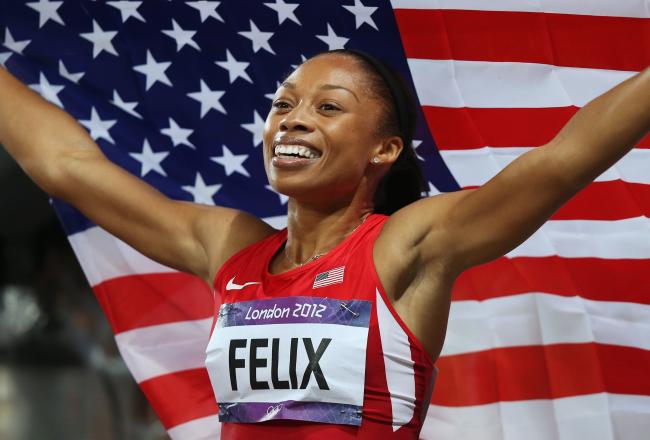
Allyson Felix Wins Gold


From the UK Guardian -- Allyson Felix's first reaction was not joy, but relief. After winning silver medals in the 200m at successive Olympic Games, each time behind her great rival from Jamaica, Veronica Campbell-Brown, Felix had finally got the gold. Felix, who says that she has been plagued by thoughts of her defeat in 2008 every night for the past four years, beat one of the greatest fields ever assembled in the history of women's sprinting. And she did it with ease. Her winning time was 21.88sec, which was some way off her best, but good enough on the night.

Campbell-Brown was trying to become the first woman in history to win sprint titles at three successive Games. She did not do it, but finished fourth. Ahead of her were the USA's Carmelita Jeter, the world 100m champion, and her Jamaican team-mate Shelly-Ann Fraser-Pryce, who was trying to become the first woman to win the sprint double at the Olympic Games since Florence Griffith Joyner did it in Seoul in 1988. In fifth was Sanya Richards-Ross, who would have been the first woman to do the Olympic 200m and 400m double since Marie-Jo Pérec in 1996. So Felix beat two current world champions, and two current Olympic champions.


The medals for Jeter and Felix tipped the ongoing sprint rivalry between Jamaica and the USA back the other way, and bumped the Americans up the athletics medal table after a disappointing few days. Surprisingly, this was the USA's first female sprint gold since Gail Devers won the 100m in 1996.

Felix did it in style, taking a narrow lead around the bend and holding on to it as the two Jamaican champions inside her came up to join her with 100m to go. Campbell-Brown began to go backwards, as Felix found another turn of speed and pushed on for the line. Jeter, in lane nine, barnstormed the finish to beat Campbell-Brown to bronze. She finished in 22.14sec, five hundredths behind Fraser-Pryce, who set a new personal best of 22.09.


Campbell-Brown and Felix are two of the great sprinters of their time. They have fought a series of duels running right back to 2004, sharing every major medal between them, and with one or the other topping the world rankings every year between then and 2011. Campbell-Brown won two Olympic golds in that time, Felix three at world championships. But there was no disguising who was the happier of the two. Felix has said she would give all three of her golds to get her hands on just one of Campbell-Brown's.

In 2004 there had been just 0.13 between them in the final, and in 2008 it was 0.17. "That 2008 final, every day since then I am always thinking about it," Felix has said. "I don't want to get that thought out of my head. It is my motivation. I've got to win, this is the one missing thing and it is the one that I want."

In 2011 Felix got so desperate for an Olympic medal that she decided to step up to the 400m too, attempting to do the double at the world championships in Daegu. She reckoned she stood a better chance of winning that elusive Olympic gold at the longer distance. In the end though, the endurance work robbed her of her sprinting speed. Caught between the two events, she won neither. Campbell-Brown won gold that time, but she wasn't the only one who took advantage. Richards-Ross and Fraser-Pryce, both sensing an opportunity, both decided to target the 200m too. Neither had ever won a medal at a major championships at that distance. All of a sudden, the 200m had turned into one of the hottest events at the Games, the field stacked with champions of one sort or another. In the space of three weeks in June and July, both Fraser-Pryce, Richards-Ross and Jeter set new personal bests, and there were only two-hundredths of a second between them.


Unhappy with the silver and bronze she won at the 2011 world championships, Felix told her coach Bob Kersee, who coached his wife Jackie Joyner-Kersee to two Olympic gold medals in the heptathlon, that she wanted to switch back to speed work and try for the 100m/200m double instead. She finished fifth behind Fraser-Pryce in the 100m final last Saturday, but in a new personal best time of 10.89. Following on from the 21.69 she ran in the 200m at the US trials, which was the fourth-quickest time in history, there was a sense that she had sheer speed in her slender legs that was going to be too much for her rivals.

Felix, the son of a church minister, reads to herself from Philippians before every race. Her favourite passage reads "If I am to live in the flesh, that means fruitful labour for me." Never more so than on Wednesday night. (source: UK Guardian)

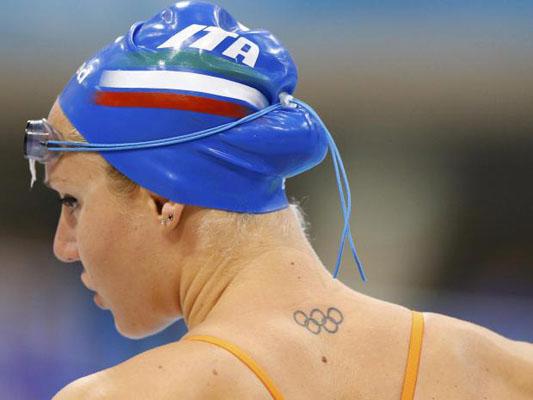
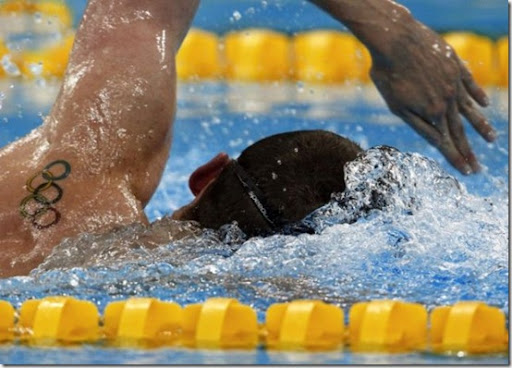
Olympic Tattoos


From ESPN, "Athletes, tourists get Olympic tattoos in London," on 5 August 2012, by the Associated Press --    LONDON -- The British capital is awash in Olympic ink -- tattoo ink, that is.

At Olympic venues around London, competitors flaunt marks of blood, sweat, tears -- and hopefully glory -- on toned arms, hips and torsos.

But tattoos of the iconic Olympic logo -- the five interlocked rings -- aren't just for the world's top athletes. Amateurs, performers at the opening ceremony and tourists as well have been inspired to get the Olympic spirit under their skin.


And it's not just in London: Thousands of miles away in Chicago, freelance writer Arika Kaosa says she is planning to ink the Olympic rings on the back of her left ankle next week.

"I love how the colors of the rings represent colors in flags of all the national teams originally in Olympic competition," said the 25-year-old, who has been following the games on television at home.

"I will use this tattoo as a positive motivator to get back into the level of performing I was previously at," said the keen tennis player.


In the Olympic host city, tattoo parlors say they have been getting some extra business from athletes and people who are involved in the games.

One potential customer they should look out for: 17-year-old American swimmer Missy Franklin, who has already won four golds and one bronze, has told reporters she wants to get an Olympic rings tattoo once the games are over.

Many Olympians like to record their achievements or tell their life story through body art -- and tattoos of the five rings are so common sometimes it seems that non-inked bodies are the minority.

The art is most visible on swimmers -- Michael Phelps has the rings on his hip, and fellow Americans Ryan Lochte and Matthew Grevers both sport them on their biceps. British diver Nicholas Robinson-Baker has a large colored one on his chest, while Canada's Brent Hayden complements large tattoos on his torso and arms with the rings -- adorned with a maple leaf -- on his back.

British gymnast Louis Smith wears a quote, "What I deserve I earn," on his back, a canvas that also features a winged cross and two large angels. Also spotted on bodies across London this week: Butterflies, a mammoth, tattoo sleeves, a Bible verse, crosses and roses.

But the plain Olympic rings are the most popular choice for tourists and fans who want a permanent souvenir of their trip.

"They're mainly Americans -- there's a hell of a lot of Americans in town," said Darryl Gates, owner of Diamond Jacks, a tattoo parlor in London's Soho area.

"A few years ago Led Zeppelin played here and we did Led Zeppelin tattoos for two weeks. That's kind of what this is like," he added.

Supporters of the British home team are getting something more patriotic.

"We did the Team GB lion logo on two athletes who came in on opening ceremony day," said Scott Maclaren at the Fulham Tattoo Center, referring to a stylized head of the animal with streaks of color resembling the Union Jack.

Those considering getting an Olympic tattoo may want to stick to the simpler designs. One American visitor picked a more elaborate one and it will make her remember the London games -- but for all the wrong reasons.

Jerri Peterson wanted to commemorate her moment as an Olympic torchbearer, but her tattoo artist, based in Georgia, misspelt Olympic. Her body art reads "Oylmpic Torch Bearer" instead.

"I looked at it and I was so disappointed. I called my husband and he giggled a little bit," Peterson, from Atlanta, told the BBC after she carried the torch through the English town of Derby. "Then I started laughing about it and I've laughed ever since."


Olympic Track Diva: Gold Medalist Sanya Richards-Ross


From the UK Guradian, "Sanya Richards-Ross intimidates Olympic rivals with the goddess look
Can the American sprinter match her Chanel gold double-C earrings with double gold victory on the track?" by Jess Cartner-Morley, on 8 August 2012  --  The peacockery that goes on in the minutes before the athletes hunker down for their races is not just a compelling element of the spectator experience of these Olympics. It is a pre-match press conference, wordless but full of clear messages. It is a part of the contest itself.


The swimmers emerge in their capes, bobbing mutely to their iPods: pure Rocky. Usain Bolt clowns around, doing a faultless impression of a competitor who isn't really focussed on the race. And then, when the gun starts, it turns out that he was just messing with our heads. Of the female sprinters, one has proved herself a champion of both the track and the starting block mind-games: Sanya Richards-Ross, winner of her 400m race and contender for tonight's 200m.


Richards-Ross emerged onto the track for that race with a look designed to both confuse and intimidate. While other runners wear ponytails or plaits - one would assume this is more practical - Richards-Ross had only the top few inches of her hair in braids, so that the rest of it tumbled in golden waves. As the TV cameras watched, she put her hands up to her hair, and it seemed for a moment she meant to tie it back - but no, she was merely fanning it out over her shoulders, the better to show off both her gleaming curls, and the large double-C gold Chanel earrings she wore. The message to her women in the other lanes was crystal clear: you may be athletes, but I am a goddess.


It was a masterclass in sporting intimidation, but also a positive statement of self-belief from an athlete who has shaken off persistent health problems to realise her potential during this Games. Lustrous hair is a signal of health and vitality; showing it off on race day sent a clear message that she believed herself to be in fine health.


Many athletes wear sentimental or lucky jewellery, Richards-Ross included: she wears around her neck a bullet her mother gave her as a schoolgirl athlete (as in: faster than a speeding bullet, apparently.) The Chanel earrings she wore to race in are more unusual, a worldly choice that made her look like she might be about to take to the stage for an arena tour, rather than run around the track. And since bling has always been a very competitive aesthetic, they only add to the aura of a woman rising to a challenge.


And then there are the clothes. Specifically, the arm-warmer sleeves, which - besides whatever physiological function they perform - serve to showcase and highlight the incredible musculature of Richards-Ross's arms and shoulders. (Many people noticed this - including, it seemed, the camera operator, who kept the lens trained on Richards-Ross for a disproportionate time.) They also look reminiscent of knee-high socks, lending a cheerleader-ish note to the outfit which will not have passed unnoticed by the runner, who is married to an NBA athlete. The sleeves add to the sense that this could be a stage get-up - Rihanna meets Britney - which in turn, helps frame the race as being the Richards-Ross show.  (source: UK Guardian)

All That Glitters Aint Gold, Silver Is Cool, Too


From the UK Guardian article written by Alice Tait, "Olympics 2012: Gold is glorious, but now it's time to salute silver: The Australian swimmer, who won two gold medals in Athens and a bronze in Beijing, all in relays, hails the runners-up," on 7 August 2012 -- A lifetime of exhaustive training, blood, sweat and tears, learning from highs and lows, relationship sacrifices and time away from the ones you love most while you travel the world seeking competition all go into one Olympic Games. Then you get your one chance – one shot at putting all of this dedication together, to create an achievement you would be proud of. The gun goes and you're off and racing, using the skills you have honed to give you the best start, using the biomechanics you spend hours and hours researching to execute the perfect physical technique, and using the guts, drive and determination to push you through the final 10m of the race when pain is searing through every inch of your body.


Dominican Republic's Felix Sanchez wins Olympic gold medal in men's 400-meter hurdles; Michael Tinsley of US wins silver

You cross the line, touch the wall or stick the landing to the best standard you could ever imagine. You turn around, check the scoreboard, and that lifetime of work is condensed down into a bright shining No2. Wow, you think, I've just won a silver medal at the Olympic Games, all of my work has paid off! You receive your medal, it's heavy, it's real, and it's yours, forever! A victory lap is completed where yes, most of the attention is paid to the gold medallist, but they wouldn't be there without you. Still buzzing, you make your way through the mixed zone of media to what you expect to be more praise and excitement. Then, you're stopped dead in your tracks …

Unimpressed: Maroney, pictured, looks distinctly unhappy as she accepts her silver medal on the podium
McKayla Maroney: Silver Medal on Vault at 2012 Olympics

"How does it feel to have lost the gold medal?" "How does it feel to be so close, but yet so far?" And the most gut-wrenching question of all: "You must be disappointed?"

Your head does a spin. Here you are, soaking up the most magnificent performance of your career, a career that you chose to do purely for the love of sport, and someone is telling you that you should be disappointed?

They call it winning a silver medal, because that is exactly what it is: winning. They only give out three medals per event. You have one day to bring your A-game, put your career on the line, and execute the best performance you can to grab one of those medals. That is why claiming a silver or a bronze medal takes winning.


Silver Medalist:  Cullen Jones, Ryan Lochte, Nathan Adrian, and Michael Phelps; London 2012 Olympic Games [Michael Dalder/REUTERS]

Now, I can comment only on what I have been able to observe from down here in Australia but I am sick and tired of athletes being almost forced into disappointment at not winning gold. All of the headlines are the same: "Seebohm falls short" (silver medal in the women's 100m backstroke), "Ginn faces defeat" (silver medal in the men's four rowing), "Magnussen sinks" (silver medal in the men's 100m freestyle).

Australia, as of now, sit 19th on the medal table with two gold, 12 silver and eight bronze medals. I will admit, based on our past Olympic performances, this is a low standing. But let's look into why this may be: John Coates, the president of the Australian Olympic Committee, blames the athletes' failure (there's that terrible word again) on a decline in government funding along with decreased participation in compulsory school sport. Kevin Gosper, as Australia's most senior member of the IOC, supports this, and adds that our coaches need to be paid more so they can dedicate themselves solely to athlete performance.

Team U.S.A. Carmelita Jeter wins the silver medal as Jamaican Shelly-Ann Fraser-Pryce wins the gold by .03 seconds.

Even our coaches aren't free from criticism, with one headline on Tuesday reading: "Aussie coaches win gold! (for another country)". Australian coaches are offered big money to take on international athletes. They can't refuse an increase in money when it means they will also be able to provide for their national athletes better. Australia put on one of the best Olympic Games the world has ever seen only 12 years ago, and was a sporting world super power – can Great Britain expect to be in our position come 2024? Here's hoping not.

The reason athletes themselves feel disappointed with a silver medal is the enormous amount of pressure placed on them to perform. This pressure comes from many places but, mostly, it comes from within; they just don't want to let anyone down. In the lead-up to an Olympic Games, so much media hype swirls around anyone who is even within a whisper of a gold medal. By the time that athlete gets to race day the expectations of the country are on their shoulders; if they fall short the entire country will be in shock.


Team U.S.A. bronze medalist Kellie Wells and silver medalist Dawn Harper

Also swirling around in the athlete's head are the sacrifices their family has made to get them to this point. With the minimal funding that is received by all amateur sports across Australia, and the world, it is rare for athletes to find themselves in a position where they can dedicate all of their time to their sport. Most hold down a job in between the six hours of training they complete each day.

More often than not, it is your family which pays for your trips away, helps you with training fees and pays for physio and massage appointments to keep your body functioning. They pay for any competition equipment you may need to put you on par with anyone else in the world, they even cook meals for you when you know that the time and money you have just won't be enough to provide yourself with adequate nutrition.

Silver Medalist Cullen Jones

Your family will always be proud, and no matter the colour of the medal, or the placing beyond that, they will hold you close and congratulate you with the best form of words they can get out without crying with joy! But you want to win the gold for them, as much as you do for yourself – and when you get silver, you do have momentary feelings of disappointment at letting your family down, even though you know you never could.

An increase in funding would allow an athlete to train, rest, and train again, without having to worry about how they are going to pay the next bill. They could exclude the pressures of performing for others, and just perform for themselves, hence bringing back the winning part of a silver medal.

Team USA Erik Kynard wins silver medal in Olympic men's high jump

So to all of this I say, let's rally together and increase funding for athletes, worldwide, so they can do what they have always dreamt to do. Let's congratulate their families for every single moment of their lives that have been dedicated towards their children's success … and let's raise our glasses to every single silver and bronze medallist at this Olympics, as well as at previous and future Games.

You have done yourselves proud, you have done your families proud and you always do your countries proud, simply by wearing your team tracksuit. Congratulations, you won! (source: UK Guardian )
United States' Leonel Manzano celebrates winning silver

8.02.2012


NBC Olympic Coverage Fails


From the  UK Independent, "As America succeeds at the Games, back home all the talk is about #NBCfail:  Host Bob Costas made a series of jingoistic remarks, including a joke about Idi Amin when Uganda's team appeared," by Guy Adams, on 30 JULY 2012


There was feverish anticipation for the debut of the USA men's basketball "dream team", who began their hugely hyped Olympic campaign yesterday afternoon. But you wouldn't have known it by turning on a television in their home country.

While Kobe Bryant and other big names in US sport were completing a 98 to 71-point victory, viewers of American network NBC were forced to watch edited highlights of a women's cycling race that had been completed several hours earlier.

It was the latest in a string of mis-takes by the broadcaster, whose coverage is sparking ridicule from TV critics and outrage from the US public. For most of the weekend, the phrase "NBC Fail" was trending on Twitter.

The broadcaster's nadir, however, perhaps occurred during the opening ceremony, which it refused to allow Americans to watch live.


When the event was screened, hours later, large portions were edited out to allow more time for commercial breaks. Yesterday, opening ceremony choreographer Akram Khan declared himself "horrified" that NBC had even decided to cut the event's tribute to victims of the 7/7 bombings.

At the centre of controversy was NBC's attempt to leverage maximum revenue from the Games, for which they paid almost a billion dollars, by foregoing live coverage of high-profile events. Instead, it intends to footage on time-delay during evening prime time, when brands will pay a premium to advertise.

The tactic may very well be the most lucrative for NBC, but it's the least satisfactory for viewers, and seems to blithely ignore the advent of the internet era.

It meant, for example, that Saturday's titanic swimming clash between Michael Phelps and Ryan Lochte wasn't broadcast in the USA until several hours after it took place. Adding insult to injury, NBC had already announced the result on its own evening news bulletin. While real-time footage is largely missing from free-to-air TV, some coverage (including the "dream team" basketball) can be found on NBC's cable channels, if you happen to pay for them. Other bits are supposedly being screened, to cable subscribers only, on a website – but it was suffering from "technical" difficulties for much of the weekend.


Even when they do find live sport, NBC viewers must suffer some of the most invasive advertising in the history of television: roughly 20 minutes during each hour is taken up by commercial breaks.

Critics have also rounded on the quality of NBC's commentary, which has been riddled with basic factual errors. They ranged from a cycling host's allegation that the Surrey countryside is full of "chateaus" to a map on NBC's website which describes Australia as "located in central Europe, bordered to the north by Germany and the Czech Republic, [and] to the west by Switzerland".

During the "parade of nations" in the opening ceremony, NBC host Bob Costas made a series of jingoistic comments about the alleged terrorist threat minor countries posed. He then joked about Idi Amin when Uganda's team appeared, and referred to the Sacha Baron Cohen character Borat when Kazakhstan emerged.

His colleagues, meanwhile, called Luxembourg "a small, central European country", said Djibouti's name "sounds funny", dismissed Australia as a "former penal colony", and admitted that they "haven't heard" of Tim Berners-Lee, the Briton who created the internet. [source: UK Independent]

3.07.2012

Limbaugh On Danica Patrick's Statement About Contraceptive Policy: "What Do You Expect From A Woman Driver?


Limbaugh On Danica Patrick's Statement About Contraceptive Policy: "What Do You Expect From A Woman Driver?"

Patricia Heaton's Tweets Like The Grand Inquisitor


As reported in the Los Angeles Times article, "Patricia Heaton: Twitter woes recall past Rush Limbaugh firestorm," on March 7, 2012:

Patricia Heaton's current woes are like deja vu all over again.

The sitcom star is at the center of a media firestorm after she apologized this week to Sandra Fluke, a Georgetown law student and contraception advocate whom radio host Rush Limbaugh infamously denounced as a "slut" and "a prostitute." Heaton, star of ABC's "The Middle," was forced to backpedal -- and temporarily suspend her Twitter account -- after a series of tweets gleefully ridiculing Fluke.

But as it happens, both Heaton, a devout Catholic never shy about airing her devotion to conservative causes, and Limbaugh have been in this type of political jam before. Together.


In 2006, Heaton agreed to do a commercial against a proposed Missouri constitutional amendment that would legalize some forms of embryonic stem-cell research in that state. Conservatives -- upset that stem-cell researchers had harvested tissue from aborted fetuses or in-vitro embryos -- turned the issue into a rallying cry. After Michael J. Fox spoke out for the amendment, reasoning that it could lead to gains in research against Parkinsonism and other diseases, Limbaugh suggested that the actor was deliberately exaggerating his Parkinson's symptoms in a ploy for sympathy.

Heaton's ad was widely ridiculed online, and its coincidence with Limbaugh's attack on Fox made the whole thing look like a mean-spirited, coordinated campaign. (The pair had also been on the same side in 2005, outspokenly criticizing the decision to remove life support for Terri Schiavo, a woman who had been in a persistent vegetative state for 15 years.)

As Heaton later told the New York Times as she rued her decision to appear in the ad: "Oh my God, it was a disaster."

So when it comes to Limbaugh, Heaton might want to write a note to herself for future reference: Do not stand next to this man.

What do you think? Should Heaton be forgiven for her occasional lapses or is she a serial apologizer who can't take what she dishes out?

Christian girl?  Actress Patricia Heaton makes $9 million dollars .... and she gets paid to pose half-naked on television, what does that make her?  Is this the sex tape that Rush Limbaugh craves?


Also reported in the March 6, 2012 Los Angeles Times--Patricia Heaton, a Twitter power-user who dubs her more than 69,000 followers "Tweatons," used the social media platform to join Limbaugh in blasting Georgetown University student Sandra Fluke for speaking out in favor of President Obama's proposal that health insurance provide free birth control.

A sample of Heaton's Tweets, since deleted: "Hey G-Town Gal: If your parents have to pay for your birth control, maybe they should get a say in who you sleep with! Instant birth control!" and "G-Gal: you’ve given yer folks great gift for Mother’s/Father’s Day! Got up in front of whole world & said I’m having tons of sex- pay 4 it!"

Catholic Inquisition.  Patricia Heaton, a devout Catholic never shy about airing her devotion to conservative causes....Beware of religious zealots.  You know a tree by the fruit it bears.  Read  Ms. Heaton's tweets, and ask yourself what kind of God does she serve?

The tweets followed Limbaugh's comments calling Fluke a "slut" and a "prostitute" and have been criticized by some as a disturbing trend toward publicly shaming women who speak openly about sex and reproductive healthcare. Limbaugh has apologized, and so has Heaton.

Many people were shocked by Heaton's support of Limbaugh -- but perhaps they shouldn't have been.

Heaton is that rarest of Hollywood creatures: an outspoken Hollywood Christian and Republican.

Patricia "Marie Antoinette" Heaton Tweets To The College Peasant Sandra Fluke

Patricia Heaton  has a net worth of $40 million. So, she can go all Marie Antoinette on all college students -- "let them wear condoms."  Of course her stupid ass wouldn't know that condoms have nothing to do with the hormone estrogen or progesterone.  

In the wake of Rush Limbaugh losing the majority of his advertising partners for comments relating to Sandra Fluke and the requirement that birth control be covered in all health insurance packages, Patricia Heaton has come under fire for her incendiary remarks.

Heaton, who many remember from Everybody Loves Raymond, apologized for a series of tweets that she posted criticizing Georgetown Law student Sandra Fluke after Fluke testified before Congress in favor of government sponsored birth control.
Patricia Heaton, is being sued by a former personal assistant, Jennifer Lee, who claims the actress fired her and then stiffed her for good measure.  She worked for Patricia from August 2007 to March 2009, earning $770 a week...Lee says friction developed after she asked about her unpaid wages -- when Patricia said Lee's child was "becoming a problem" because of the work schedule. Lee says Patricia was unsympathetic, firing her and saying "things might have been different" if Lee didn't have a child.

The Middle star joined conservative radio talk show host Rush Limbaugh — who called Fluke a "slut" and a "prostitute" last week — in trashing the Georgetown Law student and her views on contraception. Sample tweets included:

"Hey G-Town Gal: Plz let us also pay for your Starbucks, movie theater tickets and your favorite hot wings combo deal at KFC! Anything else?"

"Hey G-Town Gal: If your parents have to pay for your birth control, maybe they should get a say in who you sleep with! Instant birth control!"

"If every Tweaton sent Georgetown Gal one condom, her parents wouldn’t have to cancel basic cable, & she would never reproduce - sound good?"

The actress took home an estimated $9 million for the ninth and final season of Everybody Loves Raymond.  

Heaton deleted the offensive tweets after many fans responded negatively, and she has now apologized for her comments. She tweeted Saturday, “Mea culpa Sandra! Wasn’t being respectful 2 u re my tweets as I hope people wd b w/me. Don’t like you being dissed -so sorry.”

Rush Limbaugh also apologized for his remarks after numerous advertisers back out of his radio show. (http://www.zimbio.com/Patricia+Heaton/articles/GFss4A06DZw/Patricia+Heaton+Apologizes+Anti+Sarah+Fluk)

Rush Limbaugh and the GOP

Rush Limbaugh

Peter Gabriel asks Rush Limbaugh to remove his music


Peter Gabriel doesn't want Rush Limbaugh's radio show to use his music, in the wake of the Sandra Fluke controversy.

Gabriel's song Sledgehammer played in the background while Limbaugh called Fluke a "slut" and a "prostitute" after she testified at a congressional hearing about contraception, reports CBS News.

On his Facebook page, a note was posted from Gabriel's reps saying the rocker was "appalled to learn that his music was linked to Rush Limbaugh's extraordinary attack."

The statement adds, "It is obvious from anyone that knows Peter's work that he would never approve such a use. He has asked his representatives to make sure his music is withdrawn and especially from these unfair aggressive and ignorant comments. " (USA TODAY)

Rock Band Rush Wants Music Off of Limbaugh’s Show


*Rush, the band, wants no part of Rush, the man.

The Canadian rockers have joined Peter Gabriel in a creative boycott of Rush Limbaugh’s talk radio show after learning that one of their songs, “The Spirit of the Radio,” was also used during his rant against Sandra Fluke.

The band has filed a cease and desist letter, asking the DJ to stop playing their music.

“The public performance of Rush’s music is not licensed for political purposes and any such use is in breach of public performance licenses and constitutes copyright infringement,” the band said in a statement to Limbaugh, released Wednesday. “Accordingly, we hereby demand that you immediately stop all use of Rush’s music and confirm that you will do so.”

As previously reported, Gabriel issued a similar request after learning that his song “Sledgehammer” was used during one of Limbaugh’s rants against Fluke. (source: EURWEB)